§ 1065.644 Vacuum-decay leak rate.
This section describes how to calculate the leak rate of a vacuum-decay leak verification, which is described in § 1065.345(e). Use the following equation to calculate the leak rate, , and compare it to the criterion specified in § 1065.345(e):
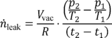 Eq. 1065.644-1
Where:
Vvac = geometric volume of the vacuum-side of the sampling system.
R = molar gas constant.
p2 = vacuum-side absolute pressure at time t2.T2 = vacuum-side absolute temperature at time t2.p1 = vacuum-side absolute pressure at time t1.T1 = vacuum-side absolute temperature at time t1.t2 = time at completion of vacuum-decay leak verification test.
t1 = time at start of vacuum-decay leak verification test.
Eq. 1065.644-1
Where:
Vvac = geometric volume of the vacuum-side of the sampling system.
R = molar gas constant.
p2 = vacuum-side absolute pressure at time t2.T2 = vacuum-side absolute temperature at time t2.p1 = vacuum-side absolute pressure at time t1.T1 = vacuum-side absolute temperature at time t1.t2 = time at completion of vacuum-decay leak verification test.
t1 = time at start of vacuum-decay leak verification test.Example:
Vvac = 2.0000 L = 0.00200 m 3R = 8.314472 J/(mol·K) = 8.314472 (m 2·kg)/(s 2·mol·K) p2 = 50.600 kPa = 50600 Pa = 50600 kg/(m·s 2) T2 = 293.15 K p1 = 25.300 kPa = 25300 Pa = 25300 kg/(m·s 2) T1 = 293.15 K t2 = 10:57:35 a.m. t1 = 10:56:25 a.m.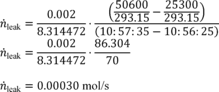
[89 FR 29808, Apr. 22, 2024]